

🔌 A guide to slowly easing into 2026
Now that we're more than halfway through January

“I don’t know why I’m so exhausted lately,” I said to Ben (my husband) last weekend.
It was only the end of the first week of January. How could I possibly be tired already?
According to my brand-new 2026 planner, it was time for a ~fresh start~. You know, time to:
Tackle my (equal parts lofty and ambiguous) New Year’s resolutions with motivation and momentum!
Become the best version of myself!
Finally finish my novel!
I’d started the week strong: apartment clean, focused writing sessions, healthy meals planned and prepped, freelance work submitted for feedback, workout classes booked, laundry done, doctor’s appointment complete, scary email sent.
Total “new year, new me” energy.
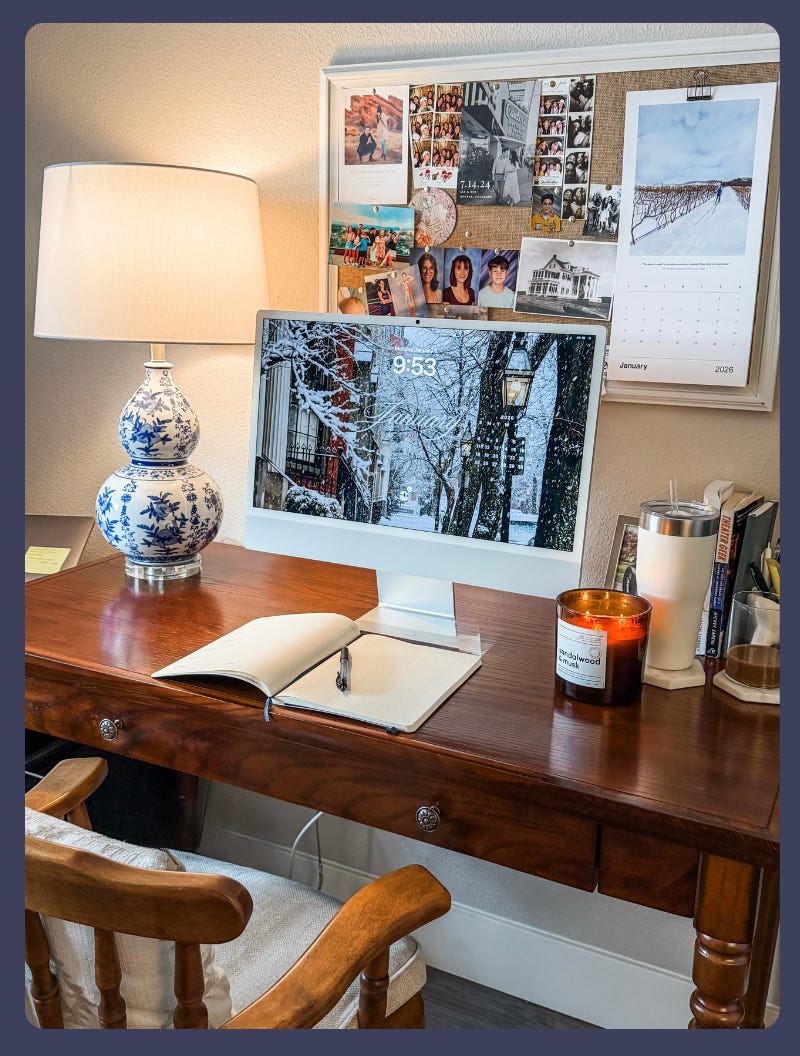
But come Thursday afternoon, I couldn’t hold my eyes open and had to take an hour-long nap. On Friday, I decided I didn’t have the oomph for a cardio workout, so canceled my weekly dance class and went to hot yoga instead. On Saturday, I took another nap after my virtual writing retreat instead of going for the walk I’d promised myself I would.
“It’s so weird—I’m just cold all the time. And craving a hot bath. And soup,” I told Ben. “Maybe I’m fighting off getting sick?” (That might explain my urge to nap, despite getting eight hours of sleep the night before.)
“Maybe it’s just winter,” he said with a shrug. “Why don’t you go rest?”
One of my favorite things about Ben is that he’s often the voice of reason when I need it most.
Why don’t you go rest?
“Why don’t you go rest?” was meant as a suggestion—but it was also a good question.
Why don’t I just “go rest”? Why do I, without fail, start January every year by putting so much pressure on myself? I act as if, when the clock strikes midnight on January 1st, I’ll suddenly reverse-Cinderella and have my entire life in order.
Growing up, my sister and I would spend every other winter break in South Florida visiting our grandparents (iykyk). And on those occasions, we’d go for long walks in their gated community, weaving our way through the palm trees and dodging golf carts, dreaming about how we wanted to go back to school like new people two weeks later: fresh haircuts, tanned, cute wardrobes, well-rested, “in shape” (what can I say? We were teens in the early 2000s.).
Twenty years later, it looks like not much has changed. Here I am, determined to kick off January 1st like a new person, when my body’s literally telling me to take it easy.
Though I’ve made strides in reminding myself I don’t need to earn my rest, I’m yet to wrap my head around the fact that we, as humans, aren’t meant to operate at the same pace year-round. When you take a step back and think about it—like Deanna Frig, Olivia Auxier, Mary Jantsch, and hannah bay do in the Notes below—winter’s not meant to be a time for high-intensity. Why try to swim upstream?
I love how Phillip Picardi puts it in Religiously Blonde:
There is nothing miraculous about January 1st. There is no need for obligatory fanfare, the stress of list-making, or the pitfalls of productivity…
But there is nothing miraculous about the date of January 1st—at least, no more than any other day of the year. Every day has the same potential to be our chance—to keep going, to start over, to try something new. Or to enjoy the slowness of life by doing absolutely nothing of note.
Don’t get me wrong—there’s nothing wrong with reflecting on 2025 or approaching January 1st like a fresh start if you want to!
But if that feels like too much pressure, that’s ok, too. Consider this your permission slip to go slowly. To not set resolutions or make a vision board or pick a word of the year. There’s no right or wrong way to go about this.
As Amie McNee reminds us:
How to ease into goal-setting mode
Truth be told, I love the idea of reflecting and setting goals more than I like actually reflecting and setting goals. 🙈
Maybe it’s because I’m constantly wondering if I’m “doing it right” (spoiler alert: there’s no such thing), or because I never know where to start.
If any of that resonates, here’s the blueprint I’m turning to for dipping a toe into the pool that is the new year—no matter when you’re reading this essay. (Love this reminder from Andrea Bartz that we can begin again whenever we want to.)
1. Ask yourself 3 questions 🔍
Zoë Björnson shared the following questions in a recent post, and I love how straightforward they are:
What are you still holding onto from 2025?
What do you want to keep?
What do you want to let go of?
No need to overcomplicate it. Just like cleaning out your closet, it’s either “keep,” “donate,” or “toss.”
If you want additional prompts, check out Zoë’s piece in ümlauts on her simple 2025 reflection tool.
I also love this passage (and these three questions) from Allie Dunin, along with her case for a slow January:
Pressure often comes from the idea that January should be transformative. That by the end of the month, you should feel different: clearer, fitter, more disciplined, more motivated.
A slower January lets go of that timeline.
Instead of asking “Who do I want to become this year?”, try:
What would help this month feel steadier?
What support do I need more of right now?
What am I not ready to change yet - and can I accept that?
Actionable shift:
Decide that January is for stabilising, not reinventing. Any habit that helps you feel a little more grounded counts as progress.
Last bit of inspo: these journaling prompts from Jenna O'Brien/Feeling! Magazine:
2. Schedule a date with yourself and turn an audit into a fun ritual ✍️
“End-of-year reflection” sounds so formal. But what if we reframe it? Can we turn it into something we look forward to, not something that feels like homework?
Maybe that means escaping to a coffee shop for a few hours with your laptop. Maybe it’s finding an outdoor spot, like a local park or beach, where you can breathe in the fresh air and take a few quiet minutes to journal. Maybe it’s waiting until everyone else leaves the house and then pouring yourself a glass of wine and dictating a voice note.
A perfect (unintentional but still relevant!) example from Candice Wiswell, PhD:
Whatever it may be, turning it into a “get to” instead of a “have to” sounds like a game-changer. If you’re looking for inspo and aren’t sure what kinds of things to reflect on, I love Hailley Griffis’s annual reflection exercise. Another great option: Nisha Sharma’s year-end audit, which I accidentally stumbled upon (thanks, Substack algorithm!) and thoroughly enjoyed.
3. Take inspo from your resolution crushes 💌
That’s a thing… right? (Welp, it is now.)
I’m not suggesting you plagiarize or stop thinking for yourself—but in the same way you might create a mood board when decorating a new space, start identifying the resolutions you’ve spotted in your feed. (Not all of them, of course—just the ones that spark an “aha” moment or make you feel seen.)
Then, try to identify trends or themes across those saved posts. They might leave clues as to what kinds of resolutions you want to set (if any), or at least offer a perspective you may not have considered.
A smattering below from my “resolution crushes”: Christina Le (always), Emma Beames, gabby, Natalie Cass, Lane Scott Jones, and Janki 🌻.
What I’m taking away from them: a desire to be more present, to say no to what doesn’t serve me, to do more things that bring me joy, to live with more intention (even when it’s scary), and to focus more on how things feel than how they look (this is the big one!).
4. Remind yourself that not all growth is neatly measured 📊
This idea’s inspired by a LinkedIn post by Mary Jantsch—a much-needed reminder that “a year is made up of far more than what can be counted, named or neatly packaged into a shareable slide… Not all growth is neatly measured.”
Look back at the last 6–12 months (or whatever timeframe feels right to you!) and jot down the moments you’re most proud of—things you couldn’t necessarily put a metric to. See how it feels.
In case it’s helpful, here’s my 2025 unwrapped for inspo. (I also loved Alyssa Reynoso-Morris’s unwrapped, available here.)
Something else I may do this year: incorporate hannah bay’s idea of creating a list of quiet markers of success, jotting down notes as I go about the moments that feel most impactful, even if they can’t be measured.
As Lindsay Hauptman puts it:
5. Pick a word of the year 💬
Confession: This isn’t usually my go-to practice. (Surprising for a word nerd, I know!) It’s not for any substantial reason—It’s just never called to me on a deeper level.
That said, I know lots of people who turn to this ritual, and I always love hearing what they choose as their word of the year and why. Some examples from my “saved” folder:
Tamara Hinckley (via this great piece on why January keeps letting you down):
That’s why my word for 2026 is enough. This year is about believing in myself. Believing that I am enough. That I have enough. And that I don’t need to keep proving my worth through output or overwork.
A Slow Living Path has a beautiful essay on how to choose your word of the year. Her pick for 2026:
I feel that my word for 2026 is EASE.
It’s something I want to experience more of in the year ahead. If last year the word chose me, this year it feels as though I am choosing it for myself.
Ease means “the absence of difficulty or effort.”
After several hard years, I find myself in a season of unlearning — letting go of the belief that everything has to be fought for. I’ve noticed how often I push, strain, or try to force outcomes and how drained I feel when I do.
In Erin’s Third Act, Erin C. Niumata explains the beauty of choosing the word. As she explains it:
A guiding word doesn’t shout. It isn’t a to-do list. It’s a whisper that stays with you daily. You can place it at your desk, on your wall, wherever you can see it so that in the still moments when you ask yourself what you’re really trying to do this year you can look at it as a compass.
Getting clear on my 2026 goals
Candidly, I’m still somewhere in between wanting to set ambitious goals and wanting to be gentle with myself this year. It feels like I’m always toeing the line between “too hard on myself” and “not disciplined enough.”
I do have some more straightforward goals for 2026 (like finishing the first draft of my WIP, editing it, and getting it ready to query!), but a few broader shifts are calling to me—changes that feel like more being than more doing.
I think of these less as hard-and-fast resolutions, and more as the primary things I want to practice this year.
1. Focusing on how things feel, not how things look
Above all else, this is the idea I keep coming home to. For so long, I’ve pursued dreams that looked good from the outside—but they didn’t necessarily truly align with how I felt on the inside. It’s time for me to lean into trusting my gut, to do things that feel aligned with the version of myself I’m becoming, and to let go of some of the “shoulds.”
Neha Ruch summed it up beautifully:
2. Learning to embrace silence and sit with my thoughts
A few years ago, my mom told me she was worried that I never gave my brain a break. “You need to give your mind time to rest,” I remember her saying. “You’re always listening to something or watching something or reading something… when do you ever take time to sit in the quiet?”
I was defensive at the time (because of course), but I quickly realized she was right. And though I made huge progress on this front in 2025 (gotta give myself credit where credit is due!), I’m still not where I’d like to be.
There are so many moments throughout the day when I automatically reach for something to fill the silence and bury my own thoughts: a podcast, a phone call, a mindless Substack or LinkedIn scroll, an episode of Love Island in the background.
Abi Bouhmaida and Ryan Hennessey each captured this feeling perfectly:
“Unplugging long enough to remember what my own mind sounds like.” That’s the ultimate goal.
3. Strength-training my attention span
This ladders up into goal #2, but it’s juuust different enough to require its own section.
In a world full of short-form video, frictionless online experiences (*cough cough Minna’s excellent piece*), and instant gratification where the answers to anything and everything are always at our fingertips (as Tuğba Avci perfectly puts it), I regularly catch my attention span diminishing.
Even when we’re watching a show at night, I feel the invisible pull to check my phone—for what, I’m not sure. Nothing pressing that needs my attention at 9 p.m. at this point in my life, but the habits are deeply ingrained. I’ve started needlepoint and cross-stitch this year, which are helpful substitutes when it comes to keeping my hands busy. But what about just sitting and being and paying attention? That part still needs TLC.
4. Supporting myself, not improving myself
Last but not least: self-care in its truest form. Not in a face-masks-and-bubble-baths kind of way (though those are great, too), but in a parenting-myself-even-when-I-don’t-feel-like-it kind of way. Listening to what my body’s telling me and following suit. (Which brings us back to #1—focusing more on how things feel rather than how they look.)
I keep coming back to this line from a piece by The Noteworthy Edit: “Feeling better is often about supporting yourself, not improving yourself.”
Easier said than done—especially when the desire to improve yourself is so deeply rooted—but maybe it’s time to meet myself where I am, at least some of the time.
So here we are, closer to February 1st than January 1st.
Happy 2026, friends. Here’s hoping we approach the next 12 months gently, being kind to ourselves and each other.




The pressure to always be on by Max Pete in Max’s Newsletter
More than anything, I want to be present again. When I check out of work, I want to close my laptop and put my phone away (even for just an hour or two to start). The goal isn’t to disappear or stop showing up entirely, but to stop ignoring that inner voice that keeps telling me I don’t need to wear the “chronically online” badge of honor to be worthy, connected, or successful.
Once again, Max proves to be inside my brain, articulating my innermost thoughts better than I ever could. If you’ve ever struggled with the need to be chronically online, the belief that being helpful = your worth, or navigating the pressure to churn out content, this one’s for you.
I am so sick of imposter syndrome by Christina Garnett in The Woman's MBA
In 2026, I pledge to stop confusing self-awareness with self-doubt.
I will no longer treat competence like an accident, success like a fluke, or experience like something that needs permission. I have earned my seat, my voice, and my perspective, even when the room feels unfamiliar.
I recognize imposter syndrome for what it actually is: a learned response to systems that were not built with me in mind, not evidence that I don’t belong.
This year, I’m going to get a lot of no’s.
Not because I’m unqualified, but because I’m going for dreams in ways I never have before.I will ask for the role, the platform, the partnership, the investment, and the opportunity that stretches me past what feels safe or predictable.
Rejection is not a verdict. It’s proof that I aimed higher.
No words needed. This whole piece is just one of those “SAY IT LOUDER!” essays that’ll resonate with literally everyone I know.
put writing first by lindsey peters berg in dear diary
I used to think I could sort of…spiritually put writing first without taking the actions required for it. “Spiritually” putting writing first meant that I consciously named writing as a top priority in my life. I took myself seriously as a writer and I understood writing to be valuable, not selfish. I talked to my friends about writing, I built writing community, I read my writer friends’ work, I read novels and researched comps.
But I saved the actual writing for “when I have time.” “When I have time” was always chaotic. Sometimes it was 10am-12pm, sometimes 2-3pm and 5-6pm, sometimes 45 minutes between work tasks. My stress and sense of urgency about all the non-writing stuff I had to do increased as the sun slunk lower in the sky.
As someone who’s constantly tempted to put literally anything and everything else first before sitting down to write, Lindsey’s piece was exactly the reminder I needed this week. Sharing here in case any fellow writers need it, too.
Thank you, as always, for being here and for reading.
“Why don’t you go rest?” - now that's love. 💕
I love goal number one. Excited to hear how things evolve for you this year.