

🔌 When to push through vs. when to bounce back
Thoughts on endurance, resilience, and when to leverage each

A few weeks ago, at the request of a friend, I posted some tips for how to recharge without quitting your job—a theme that’s crescendoed for so many of us over the past few years, especially in the wake of COVID as we’ve examined our values and relationships with work, capitalism, and corporate America. (Or maybe America in general? But anyyyyway).
I’m so grateful to everyone who’s liked, commented on, shared, or saved that post. It’s been a powerful reminder that we’re not alone as we navigate these complex shifts and reevaluate our priorities.
There’s one piece of feedback to that piece that I can’t stop thinking about, and it’s this comment from Liza Dube, a leadership and career coach I’ve had the pleasure of meeting through the MKTG WMN community.
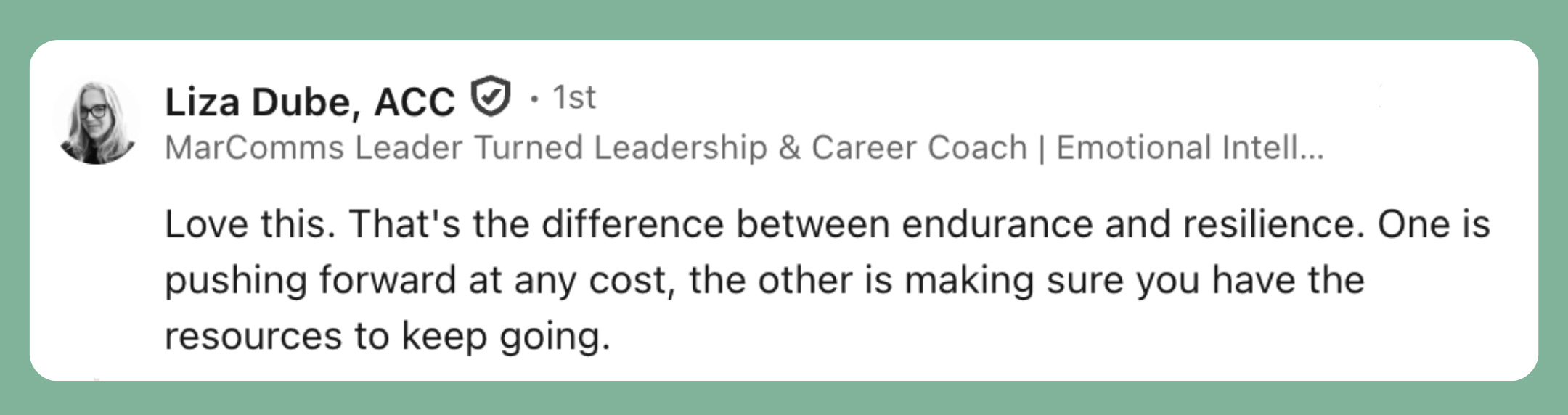
I’d never really thought about the difference between endurance and resilience, but once I saw it, I couldn’t unsee it. Talk about a lightbulb moment! (Thank you, Liza!)
So let’s get into it, shall we?
NOTE: All books linked in the recharge are affiliate links for bookshop.org, but I only share the titles I truly recommend. You can find the full list of recharge recs here.
Endurance vs. resilience
Both endurance and resilience serve a purpose. And in our careers, we need a little bit of each.
So what’s the difference?
Endurance is the ability to sustain a difficult or unpleasant activity over a long period of time. It’s the power to keep going despite fatigue, pain, or other adverse conditions, also known as stamina.
Resilience is the ability to adapt well in the face of adversity, trauma, tragedy, threats, or significant stress. It’s the process of “bouncing back” from difficult experiences, which can also lead to personal growth and improvement.


Think of it like being in the thick of it vs. bouncing back afterward. A helpful analogy from BetterUp:
“Both concepts are related to how you deal with difficulty.
If you walk down a path uninterrupted, you’ll start to feel tired. Endurance is your push to keep going, despite the fatigue.
Now, let’s say you walk down that same path and encounter a fence. Resilience is your capacity to 1) hop the fence and 2) rest and recover before continuing down the path.”
The bad news: neither endurance nor resilience is easy.
The good news: both endurance and resilience can be cultivated and learned over time.
Ben (my husband) and I were chatting about this the other day, and he raised a great question:
Can you really have one without the other?
Can you?! They’re deeply intertwined. I (ok, fine, we) would argue that endurance requires resilience, but resilience doesn’t necessarily require endurance. (Kind of like how a square is a rectangle, but a rectangle isn’t a square…).
But curious to hear YOUR thoughts. Can you have one without the other? And which are you leaning into in this season? Or have you turned to in the past?
Join the convo. 👇
🧱 3 tips for building endurance
You know the saying, “It’s a marathon, not a sprint”? Think entire career trajectories, long-term projects, roles you know you need to stick with for at least a year, literal marathons (not that I’d know, but shoutout to those who do).
Here are a few of the mental tricks I’ve tried to play on myself in the past when I’ve felt burnt out, but knew I had to find some way to power through.
1. Reframe “I have to” → “I get to”
James Clear goes into this in Atomic Habits (which Ben just read and I need to revisit!), but this hack has become a staple for me. At various times in my career, I’ve even written “I get to” with a Sharpie on a Post-It note and kept it somewhere visible, like on the current page of my planner or on a bulletin board by my desk.
To this day, I remind myself, “I get to” when it comes to anything I’m not particularly looking forward to or in the mood to do: finalizing a freelance deliverable, running to the grocery store, taking Waffles out when it’s cold and dark. Positioning to-dos as opportunities works like a charm for me 9 times out of 10.
2. Find new avenues that interest you
At various points in my career when I’ve felt bored, restless, or disengaged, I’ve found luck in picking something new (but adjacent/relevant!) to focus on learning or improving.
My clearest memory of this was at WeWork.
Performance reviews and promotion cycles were irregular during my first few years there, and job titles (and descriptions) were ever-changing. Leadership took pride in playing musical chairs with the members of the C-suite (no, seriously):
The Chief Creative Officer was made the Chief Culture Officer
The Chief Legal Officer was made the Chief Operations Officer
The Chief Product Officer was made the Chief Growth Officer
And that’s just the tip of the iceberg.
Sometimes it felt like that strategy trickled down to the rest of us. You weren’t necessarily promoted or demoted… but it wasn’t unusual to come into work one day to find someone else had been hired to do the thing you thought you were supposed to be doing (either as a consultant or full-time), or to find out in new hire orientation that someone had been brought on to lead a new vertical you had no idea existed, or to show up to a team meeting and find someone from an unrealted org running a workshop on how to approach your area of expertise. (Never a dull moment! 🙃)
Around 2019 (at which point I’d gone from social media manager → senior social media manager → director of social media → director of international social media), I was absolutely burnt out and ready for a change—but, with a potential IPO looming (lol), I wasn’t ready to throw in the WeWork towel.
I doubled down on people management as my adjacent topic of choice and decided that at least 60% of my energy would go toward developing my managerial skills instead of my social media skills. (In hindsight, a great investment!) I devoured Julie Zhuo’s The Making of a Manager and as many books in the Harvard Business Review’s management collection as I could, and in the process, found that detour was enough to reignite my interest in the job. (Not necessarily a long-term solution, but it helped me through the doldrums.)
3. Remind yourself that “this too shall pass.”
It’s so straightforward, but the simple reminder ”this too shall pass” has gotten me through MANY a challenging moment, both personally and professionally: my AP calc exam, all-nighters in Van Pelt Library studying for finals, tight deadlines that I was panicked about hitting. (Calling to mind the first Teal research report that we published, where I was in tears over not feeling like I knew what I was doing.)
Nothing lasts forever—both a blessing and a curse. But in the moments where you’re miserable, wishing you were literally ANYWHERE else, it’s like a breath of fresh air to remind yourself that this current situation isn’t permanent.
💪 3 tips for building resilience
I’d argue the three most valuable tools in anyone’s career toolkit are:
A growth mindset (i.e., the belief that your abilities, intelligence, and skills can be developed through effort, learning, and practice over time, rather than being fixed traits you’re born with)
Resourcefulness (i.e., the ability to figure shit out and find creative solutions with limited resources or in difficult circumstances)
Resilience (i.e., the ability to recover from failure, disappointment, or rejection, and/or adapting when plans fall apart)
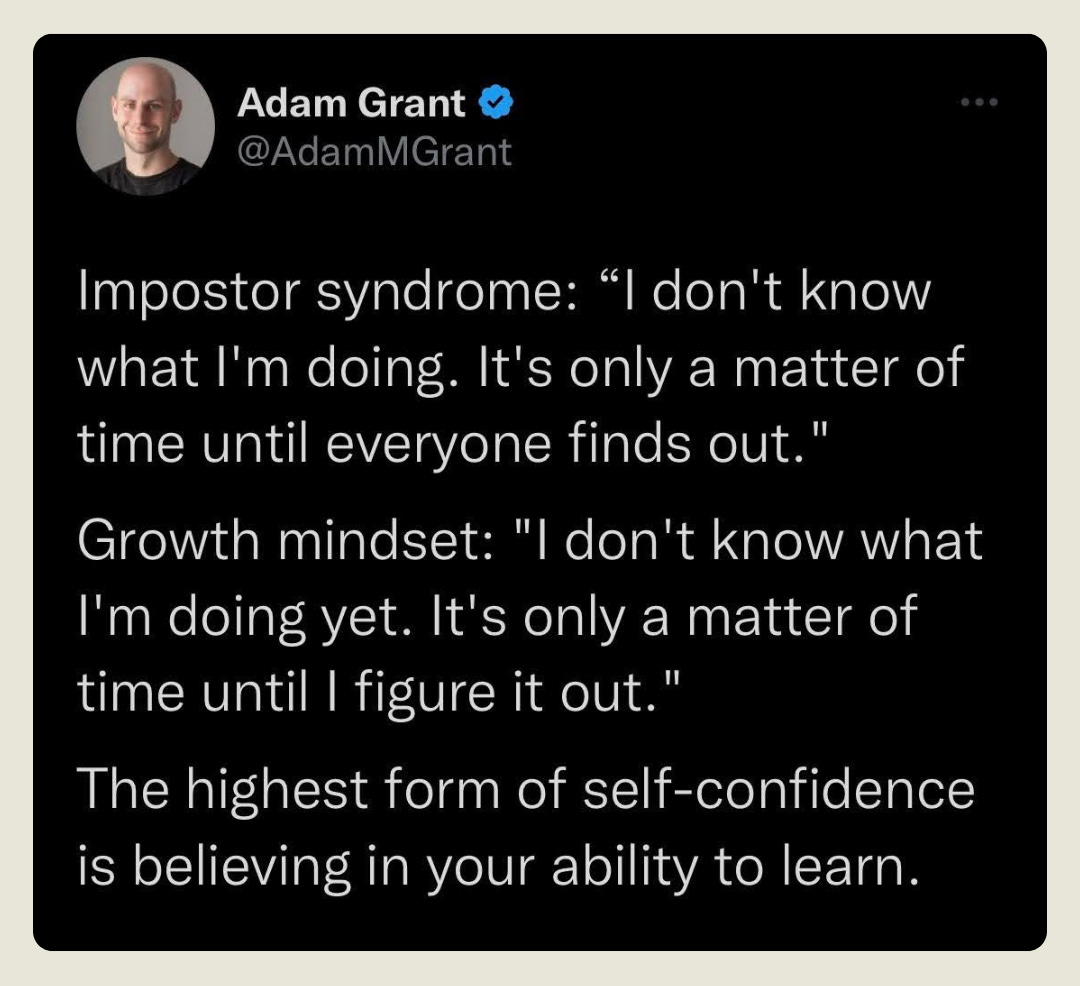
Here are the ways I’ve worked to cultivate resilience (and you can, too):
1. Remind yourself that rejection = redirection
I don’t mean that in a Pollyanna way, truly. Rejection stings, no matter how you look at it. We may not be able to control outcomes, but we can control our interpretation of rejection and what we do from there.
Admittedly, I’ve never been one to handle rejection well. Any time I’ve been cast in the ensemble of a show instead of a speaking role, I’ve been heartbroken. (As I type this out, I realize how absurd it sounds. But hey, it’s honest.)
I remember applying for a role at an HR tech company in 2021 (before my freelance chapter), confident that my background was a great fit and that I could easily transfer my experience in social media to their open internal communications role. And I remember being disappointed when, even after a referral and introduction from a friend who worked there, I didn’t even land an interview.
But that “no” meant a “yes” to something else: starting my own little LLC and working for myself, which ultimately led me back to an in-house role at Teal.
Paths like that are always easier to make sense of in hindsight, of course. So when things don’t go as planned, I try to remind myself that someday I’ll look back on this moment and be glad things unfolded as they did. I don’t know if I 100% buy into the idea that everything happens for a reason, but I do think that some things just aren’t meant to be—and usually for the best. You know, the whole “when the universe closes a door, it opens a window” philosophy.
It’s up to us to reframe rejection as an opportunity and, in doing so, cultivate resilience.
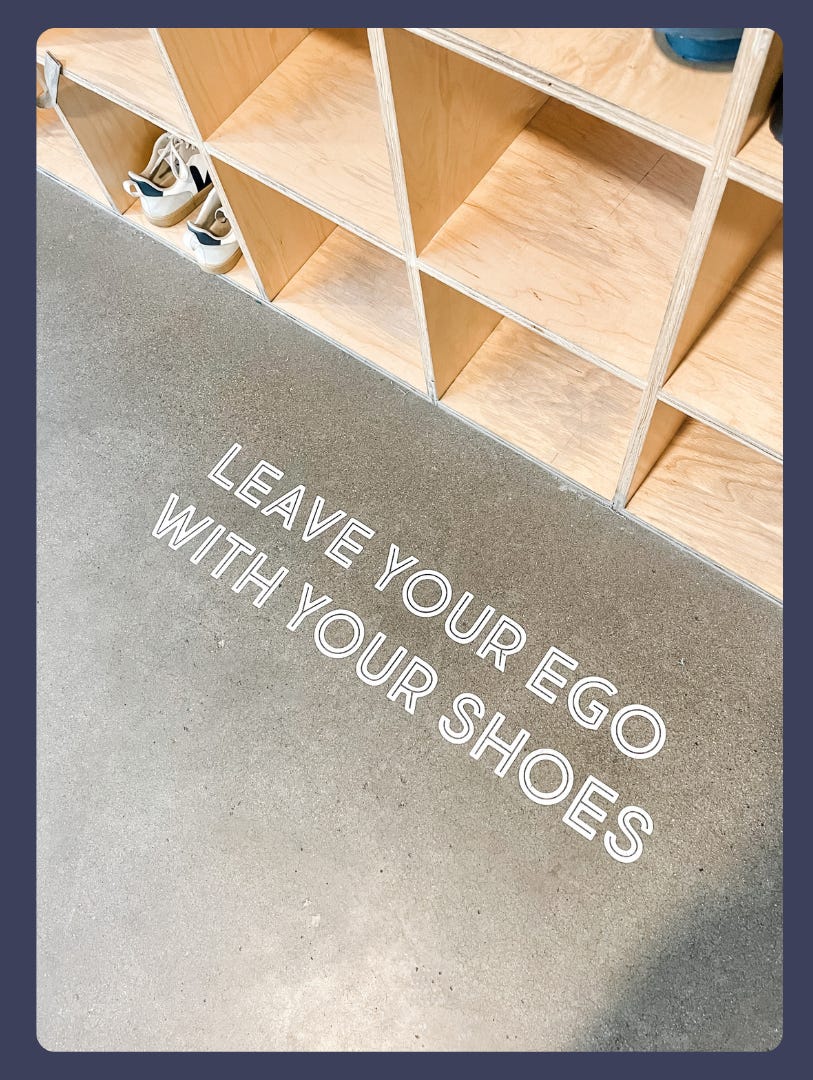
2. Drop your ego
I know, I know—easier said than done. Putting my ego aside has consistently been one of the hardest things to do—but also one of the most rewarding.
When I made the jump from Head of Social Media at WeWork to Head of Brand & Content at Teal, impostor syndrome hit hard—and then even harder when I was promoted to VP of Marketing. These were not only brand-new titles in areas where I felt anything but confident, but also external markers of being someone who knew what she was doing. And those roles felt like huge shoes to fill. (Speaking of, see photo below.)
There were MANY, many times throughout my time at Teal when my ego was challenged: consultants and experts brought in to advise on areas that I was scolding myself for not understanding better. (Even things like social media, where I was territorial and defensive—I’d spent 10+ years in that space. Wasn’t that good enough?!)
But the more I tried to take my ego out of it and lean into collaboration over competition, the more regulated my nervous system felt, and the less panicked I felt about, Does this mean I’m going to be fired?
I found myself more comfortable asking basic questions, less afraid to be (or be perceived as) a beginner, and at ease leaning into the admission of not knowing.
As Mary Jantsch puts it in 33 Things I Know About Not Knowing (a must-read, btw!):
“You’re adding a book to your Library of Resilience: Each experience with uncertainty builds your capacity to stay present, adapt, and recover. Like a librarian, you can return to these lessons and decide which ones to pull off the shelf and reference. You might have to reread a few chapters more than once, but the library is there, and it’s yours.”
3. Don’t try to “push through”
It sounds counterintuitive (see tip #1 in this piece!), especially when all you want to do is push through, but endurance isn’t always the answer. Sometimes, the best thing we can do is pause to regroup and rest before moving forward.
If endurance is about stamina, resilience is about knowing when to recover.
I love how Kristen Warms puts it: “Resilience can be soft.”




I’m Tired of Hustling When Most of Us Are Just Trying to Survive by Eric Woods in The Marketer's Career
“This system is explicitly designed to keep you running. More work will always be there. The grind isn’t going anywhere. Capitalism will continue demanding more of you than you can give. The secret to leading a fulfilling life, if there is one, then becomes finding the ability to stop running. Hit the brakes, and look at what’s happening right now in front of you.”
Truth be told, I wanted to highlight every other sentence in this piece. SO many great thoughts and takeaways on hustle culture, the ambient nature of work these days (love that framing!), and the importance of slowing down in a world that often demands the exact opposite.
Why We Idolize People Who “Move In Silence” by Ali Kriegsman in New Motives
"To me, we pedestal ‘moving in silence’ and those who are chronically offline because they don’t need to be seen to feel worthy. They don’t need our attention or validation. They are immune to the grand illness of our age, which is to believe that if it’s not logged, it’s not real.”
This gem from Ali is a must for anyone who’s heard the saying, “Offline is the new luxury,” and wants to dig in deeper. I love how she examines the why behind it and the power of moving quietly in an age “where everyone is addicted to attention and vying for validation online.”
Whose Cup Are You Filling? by Derek Thompson
“Our attention is the revealed preference of our values. Many people spend their whole lives emptying themselves without taking stock of the water levels of the cups into which they pour their existence. They spend hours, days, and decades watering cups that they never meant to water and leaving empty other vessels they always meant to fill.”
A few weeks ago, over dinner, my sister’s father-in-law put it like this: “Your first meeting of the day is with yourself.” And this excellent piece was a great reminder of exactly that. As I step back into the rhythm of working with more than one client and setting boundaries, learning to pour my energy into the right cups has become even more pressing.

Part diary so I have this to look back on at the end of 2025, and part “things I text my loved ones” shared more widely.


📚 Reading: Flew through Karin Slaughter’s latest book, We Are All Guilty Here (a page-turner, per usual!), and Broken Country by Clare Leslie Hall (LOVED). I need some recs for our upcoming honeymoon—anything you’ve read lately that you can’t put down? Let me know!
🎞️ Watching: Sad to report we struggled to get into House of Guiness. We finished Task and are still making our way through Slow Horses (liking it, but not as much as previous seasons). Oh, and we’re watching the second season of Nobody Wants This. As my guilty pleasure while doing laundry, etc., I just binged Love is Blind season 9 (and called out every time I recognized one of the filming locations, which I’m sure didn’t annoy Ben at all). On the movie front, we saw Springsteen: Deliver Me from Nowhere. (I’d say it’s not bad, but not worth rushing to theaters… I wanted to like it more than I actually did.)
🤓 Learning: How to use ChatGPT’s new browser, Atlas. I have so many complicated feelings about AI: the ethics, the environmental impact, the equity in who has access to paid plans, and what it means for the future of work. I could go on for hours. But admittedly, I’m also curious about the new features, the way it’s transforming the internet, and the capabilities we don’t even know about yet. (More on LinkedIn here from my former colleague Oshen on the various AI browsers and their implications.)
🍴 Eating: The best baklava from a Turkish coffee shop in Walnut Creek, fresh sourdough bagels from Bones Bagels in SF, and spicy Caesar salad (and pizza!) from Rose Pizzeria in Berkeley—a carb lover’s dream, basically.
👩🍳 Cooking: Meal prepped some cute lil’ egg bites the other week with pancetta, arugula, onion, tomato, and cheddar. Oh, and chocolate chip cookies for a dinner party my sister and brother-in-law hosted. Also made this extra veggie chicken enchilada soup last weekend—perfect for the fall!
🍸 Drinking: Water out of my Owala water bottle. I caved after years of debating—and can safely say it’s well worth the investment.
🎧 Listening to: The Runaway Country podcast, hosted by Alex Wagner. I’ve been trying to find more women-hosted shows to listen to (to supplement the fantastic Jessica Yellin (News Not Noise) and Heather Cox Richardson (Letters from an American). Any other recs? I’d love to hear ‘em! (Especially diverse voices, please! Much as I (generally) love Ezra Klein and appreciate parts of Pod Save America, there’s only so much I can take of hearing white men1 talk to themselves.)
🛠️ Doing: A lot over the last few weeks!
Hosted our first Secret Date Night (Couples Edition) with my sister and brother-in-law. (We planned this round: dinner in Berkeley and then the Cal/UNC football game!)
Attended the No Kings protest in San Francisco, which was SO encouraging and good for the soul (and, selfishly, my step count).
Took Waffles to Camp Bow Wow for a doggy daycare/boarding interview. 🥹
💛 Simple pleasures: Cozy, rainy fall mornings, and dinner parties with family and friends that make you feel like you’re literally in a movie.
💭 Obsessed with: The nationwide coverage of the No Kings protests—both in cities where the crowds move in waves and in small towns (and historically conservative areas!) where it takes extra bravery to speak out.


👀 Looking forward to: Seeing SUFFS this weekend! (Shaina, who wrote the book, music, and lyrics, is a friend and former roommate from my theater camp days, and I’m freaking out.) Also looking forward to our honeymoon!!!! We’ll be away for a big chunk of November, but expect lots of photos when we’re back.
Thank you (as always) for being here and for reading. 🤍
Not all white men. In case that needed to be said.
Such a great piece! I definitely think resilience is the practice that enables endurance over time. The more comfortable you get with the uncomfortable the more you can do!
Love this! Honored to be included. I agree re: with you about the difference between endurance and resilience. Resilience is about flexibility -- adapting to circumstances, or reshaping oneself anew because of them). Whereas endurance is basically about pain.