

🔌 When burnout comes from caring too much
MKTG WMN co-founder Natalie Cantave on what happens when you keep rising to the occasion—without realizing your energy is quietly being depleted


Welcome back to Real Recharge Stories—an interview series featuring people who’ve navigated burnout and the roadmaps they’ve used to come home to themselves. Want to share your story? Let me know! I’d love to chat. 💌

Natalie Cantave and I first crossed paths a few years ago, when she reached out to me about participating in a virtual conference for MKTG WMN—an incredible community for women and nonbinary marketers that she co-founded. (Casual.)
Over the years, I’ve watched in awe as Natalie and her co-founder, Gabrielle, have built a community from the ground up—not in a buzzword kind of way, but in a genuinely helpful, this-place-forms-real-relationships kind of way. Not easy, especially in this day and age.
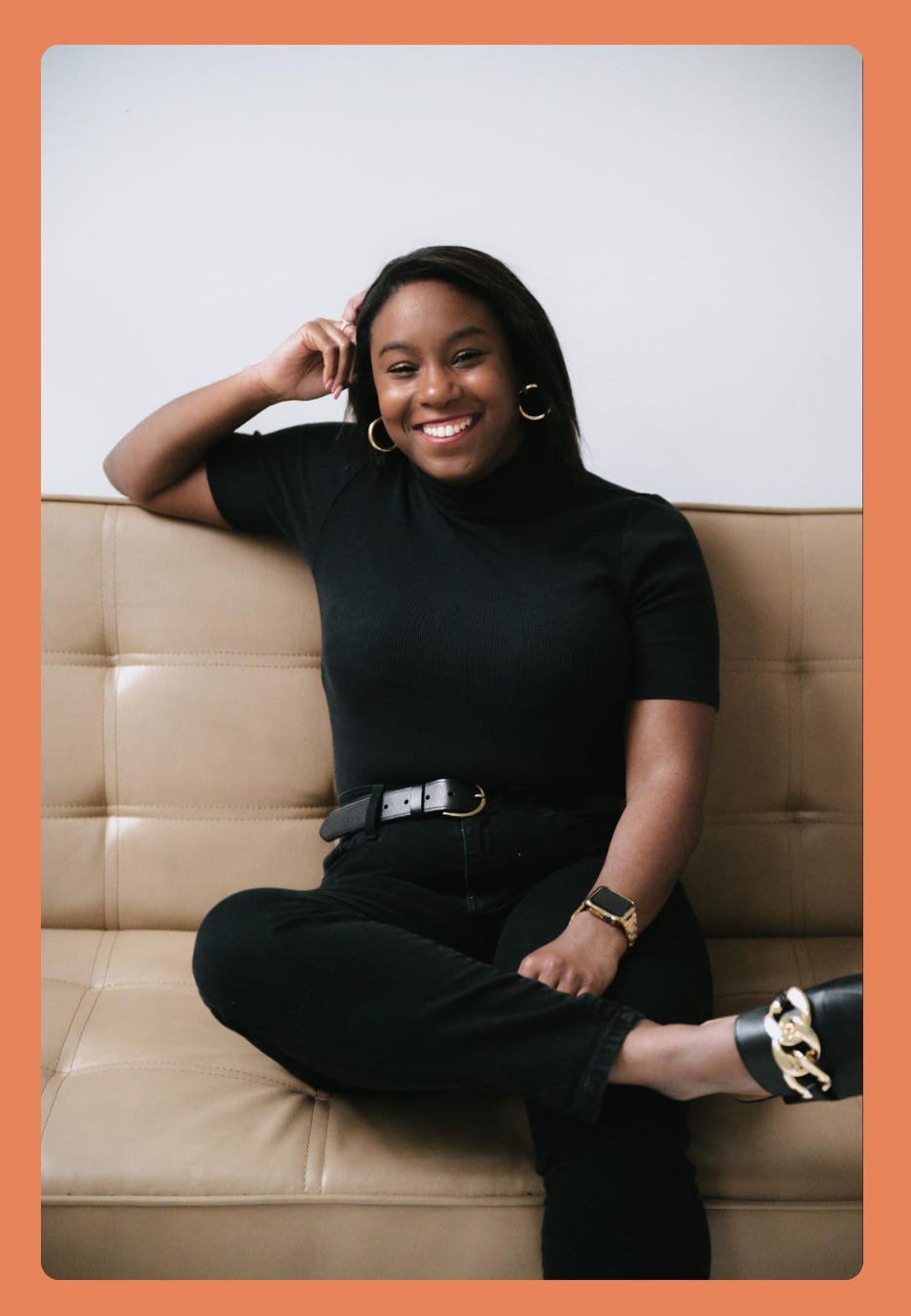
When Natalie announced she was taking a sabbatical from MKTG WMN, I knew I wanted to hear her story. What does it look like when you burn out not from your primary job, but from a passion project? Lucky for me—and all of us—Natalie was open to sharing her story.
Read on for her thoughtful take on topics like:
The kind of burnout that comes from caring too much for too long without enough separation from work, identity, and responsibility
Taking a sabbatical from a project you care about deeply—and framing it as an opportunity to create intentional distance
What she thought rest looked like (vs. what it actually looked like)
The trap of tying your identity to being dependable, productive, responsive, or helpful
A sneak peek at the premise of her romance novel (!!!)
You know what I’m about to say: Thank you for being here and for reading. (As always.) Appreciate the support so very much.
P.S. IYKYK: Substack is telling me this post is too long for email—so if it gets cut off, please try viewing it in your browser or in the app. Now, over to Natalie!

👋 Part 1: Meet Natalie
Tell us a little about who you are!
I’m Natalie, a marketing and events leader based outside of Boston by way of New Jersey. Professionally, I work in B2B SaaS and fintech, helping lead large-scale experiences, executive programming, and relationship-driven marketing initiatives.
Outside of my day job, I’m the co-founder of MKTG WMN, a community built to support women and nonbinary marketers through honest conversations, career growth, mentorship, and connection.
A lot of my career has centered around building things that bring people together and make them feel less alone, whether that’s conferences, communities, events, content, or intimate spaces where people show up as their authentic selves.
What are some of your favorite things?
Quality time with my partner Scott, family, and friends
Snuggles with my cat Pax
Traveling
Live music / going to concerts
Spring and summer seasons (and wardrobe)
A nice glass of white wine OR a gin-based cocktail like a Bees Knees
Watching Real Housewives franchises (Potomac, Atlanta, Beverly Hills, Salt Lake City) — I’m currently watching Rhode Island
Reading
A beautiful summer day
Fall in New England
A mani/pedi and getting my hair done (I’m just a girl LOL)
What does your elevator pitch sound like these days?
Honestly, it changes depending on the season I’m in.
Right now, I’d say that I’m someone who sits at the intersection of marketing, experiences/events, and community. Professionally, I specialize in high-impact events, content, and relationship-driven programs for fast-growing tech companies. Personally, I care a lot about creating spaces where ambitious women and nonbinary marketers can have more honest conversations about career growth, leadership, identity, and everything in between.
At the core of everything I do—whether it’s a conference, community event, podcast conversation, or intimate dinner—I’m really interested in how people connect and how experiences can make people feel empowered, energized, and inspired.
Can you walk us through your career trajectory? What about it has been nonlinear or surprised you?
My career has definitely been nonlinear, in the best way. It started as a Dartmouth alum with a psychology major (and global health certificate) who somehow landed in tech/startup environments where I operated on lean teams and learned to wear multiple hats at once—everything from content and communications to partnerships, events, brand, and community-building. Those environments taught me to think strategically while being deeply executional.
Over time, I realized I was especially drawn to experiences and relationship-building. I reevaluated my relationship with healthtech during the pandemic, and after losing a grandmother and seeing firsthand how difficult navigating finances and estate planning can be for families, I was drawn to fintech.
One thing that surprised me is that many of the skills that initially felt undervalued—emotional intelligence, listening, relationship-building, storytelling—ended up becoming some of my greatest strengths and have served me well throughout my career.
Many of the skills that initially felt undervalued—emotional intelligence, listening, relationship-building, storytelling—ended up becoming some of my greatest strengths and have served me well throughout my career.
Can you tell us more about MKTG WMN and its origin story?
I met my co-founder, Gabrielle Dalvet, at a Boston-area marketers’ networking event years ago, and we stayed in touch through honest conversations about our careers, goals, frustrations, and experiences navigating marketing.
We kept hearing things like:
“Am I underpaid?”
“Why is Sean getting the promotion when I’m doing all the work?”
“Why does marketing feel emotionally exhausting sometimes?”
“What if I don’t want to become a CMO? What does my path look like?”
At the same time, a lot of professional communities felt overly polished, niche, or transactional. We wanted to create something that felt more human.
So MKTG WMN became a space for candid conversations around career growth, burnout, compensation, identity, and navigating an ambitious career regardless of the environment/industry/path you’re in or on. We wanted to build the kind of “batphone” network many women and nonbinary marketers don’t naturally have access to—trusted people you can go to for advice, feedback, negotiation help, mentorship, or reassurance that you’re not alone in what you’re experiencing.
We wanted to build the kind of “batphone” network many women and nonbinary marketers don’t naturally have access to.
As a co-founder of MKTG WMN, what’s your purview? Do you and Gab divide responsibilities?
Gab and I divide responsibilities, but naturally, there’s a lot of collaboration because the community is so relationship-driven.
Gab has more responsibilities, especially when it comes to partnerships, revenue, operations, and member growth, since I’m balancing MKTG WMN with a full-time job. A lot of my focus centers around programming, in-person events, content, and community experience.
Coming back from sabbatical, I’m especially excited to become more involved in programming, in-person events, and longer-term strategic growth opportunities while also thinking more intentionally about sustainability and structure.

❤️🔥 Part 2: All things burnout & recovery
Most of the Q&As I’ve shared so far involve burnout from a corporate job—but I’m so curious about the type of burnout that comes from being a co-founder, especially when it’s on top of your day job.
Can you tell us more about that? What led to your decision to take a sabbatical from MKTG WMN?
What made this burnout different (for me) was the fact that it came from caring too much for too long without enough separation from work, identity, and responsibility.
MKTG WMN is incredibly meaningful for me. But when you’re co-founding something community-driven while also working a full-time role, the lines between passion and labor can disappear quickly. You’re carrying strategy, options, programming, relationships, visibility, community care, and more all at once.
Community-building creates a very unique type of burnout because people don’t always see the invisible labor involved. You’re not just running events or creating content—you’re holding space for women and nonbinary marketers’ careers, anxieties, ambitions, frustrations, and identities while also trying to navigate your own (personally and professionally).
Community-building creates a very unique type of burnout because people don’t always see the invisible labor involved.
At a certain point, I had become someone who was always “on.” On for my colleagues. On for the MKTG WMN community. On for friendships and relationships.
I could never allow my brain to actually rest.
To be honest, it eventually started to turn into resentment because I could never have enough energy to pour into myself. That—combined with recurring migraines that would completely knock me off my feet and tough love from Gab to take a break—pushed me to make the decision to step back.
The sabbatical wasn’t about walking away from MKTG WMN; it was about creating enough distance to be kinder to myself, reevaluate the systems and expectations I’d built for myself, and think more intentionally about the rhythms and routines I want long term.
And honestly, that’s just the professional side of me—we haven’t even gotten into who I am outside of work.
The sabbatical wasn’t about walking away from MKTG WMN; it was about creating enough distance to be kinder to myself, reevaluate the systems and expectations I’d built for myself, and think more intentionally about the rhythms and routines I want long term.
How did you spend your time when you were on sabbatical? Did it still feel like enough of a break, given you were still online?
In some ways, yes, and in some ways, no.
While I stepped away from the day-to-day of MKTG WMN, I was deep in planning my company’s annual user conference—and helping to scale it significantly. So while I was “offline,” I wasn’t really offline.
But while on sabbatical, I realized that rest doesn’t look like a perfect morning/evening routine or going off the grid. Sometimes rest is redirecting your energy from one type of labor long enough to breathe differently, or easily.
I spent a lot more time with my partner and cat, reconnecting with creativity, and reading fiction and romance novels (and even drafting one of my own!). Weirdly enough, writing fiction felt restorative in a way I didn’t expect because it activated a different part of my brain than the one constantly thinking about execution, deadlines, strategy, and logistics.
Rest doesn’t look like a perfect morning/evening routine or going off the grid. Sometimes rest is redirecting your energy from one type of labor long enough to breathe differently, or easily.
Wait—you’re writing a novel?! Tell us more.
HAHA! So to be honest, it started out of inspiration from one of my best friends from college, Emily, who is working on an amazing queer sports romance novel that I was reading/giving her feedback on, combined with encouragement from my therapist.
Usually in the winter, I feel the seasonal blues living in New England. I found some of my usual outlets weren’t working like they used to, and realized I needed a creative outlet that had nothing to do with productivity.
I’d done the puzzles during the pandemic (unsuccessfully), tried a coloring app on my iPad, cooked new recipes (without getting into bread-making). So my therapist was like, “Why don’t you write a novel? You don’t need to publish it unless you want to, but it can be just for you.”
So with the blessing of my therapist and the immediate support from Emily, I started writing a romance novel that takes place in DC—a love story between Theo, a college professor, and Elena, an entrepreneur and events professional, inspired by my relationship with my partner, Scott.
It’s been fulfilling to exercise a different part of my brain that cares about storytelling, not in a way that needs to drive leads or event attendance, but in a way that connects with people emotionally.
[Editor’s note: I cannot wait to buy my copy when it hits shelves!]
What did you learn about yourself during your sabbatical? Did it change how you’re thinking about your role, boundaries, etc., at all?
I learned the hard way that I’m very good at functioning while exhausted, which isn’t a healthy thing.
I also realized how much of my identity had become tied to being dependable, productive, responsive, or helpful. This can become a trap if you’re not careful.
The sabbatical forced me to think more intentionally about boundaries, structure, and what kind of pace I actually want long-term. I’m still figuring that out, honestly, but I think I’m much more aware now of what this looks like.
I realized how much of my identity had become tied to being dependable, productive, responsive, or helpful. This can become a trap if you’re not careful.
You wrote a beautiful message to the MKTG WMN community when you came back (shared below). How did you come to notice this when given the time and space? Was there something specific that felt like an aha moment?
“Stepping away also gave me just enough distance to notice something very clearly: being a woman in marketing in 2026 somehow still means doing a lot of the work, carrying a lot of the pressure, and still having to prove you can handle the big moments before anyone calls you a leader. And if you’ve felt that recently, you’re definitely not imagining it.” — Excerpt from Natalie’s note to the MKTG WMN community
Distance gave me perspective.
When you’re constantly in execution mode, you normalize things that aren’t actually sustainable for the long term. During my time away, I realized that women and nonbinary marketers are expected to perform long before they’re actually granted the recognition, authority, or credit (like a raise or promotion) that they deserve.
We’re often expected to be strategic, emotionally intelligent, collaborative, highly responsive, execution-focused, calm under pressure, adaptable, not aggressive—all at once.
And because marketing is such a relationship-driven function, so much of that labor goes unnoticed.
There wasn’t a singular “aha” moment so much as a gradual realization that many women and nonbinary marketers are carrying an unsustainable amount of pressure while still feeling like they have to prove themselves over and over again before being seen as leaders.
Personally, this is something I’m still grappling with. But I think I’ve gained enough distance to finally see the weight of it more clearly—and figure out how to carry it differently.
Many women and nonbinary marketers are carrying an unsustainable amount of pressure while still feeling like they have to prove themselves over and over again before being seen as leaders.
What routines, rhythms, or rituals helped you move through burnout?
Reading fiction (especially romance or mystery novels) honestly helped me a lot. There’s something really restorative about immersing yourself in stories that have nothing to do with deadlines, spreadsheets, and PowerPoint decks.
Therapy was/has been a huge support system for me. I also enjoy long walks, spending time with my partner and friends, experimenting with cooking one new recipe a month, traveling, listening to music, and even watching reality TV shows helped more than I expected.
Surprisingly, writing fiction became one of the biggest outlets for me because it’s been a different and fun challenge for a different part of my brain.


What’s one common misconception people have about burnout that you disagree with (or have a contrarian take on)?
That burnout only happens when you hate your job or when your workplace is toxic.
Sometimes burnout happens because you deeply care. Because you’re good at what you do. Because people trust you with more and more responsibility. Because you keep rising to the occasion without realizing that your energy is quietly being depleted—and you’re not taking the time to pour back into yourself.
I also think people assume burnout can be solved with a vacation or a few days off. But often what actually needs to change is your relationship to work, responsibility, accessibility, and systems that set you up for success.
Sometimes burnout happens because you deeply care. Because you’re good at what you do. Because people trust you with more and more responsibility. Because you keep rising to the occasion without realizing that your energy is quietly being depleted—and you’re not taking the time to pour back into yourself.
You were still working a full-time job during your sabbatical from MKTG WMN—is there any advice you’d give someone who can’t fully unplug?
First: rest is restorative, no matter how long it is. It still counts.
I think social media sometimes creates this unrealistic picture that healing or rest has to look perfect, or that you have to fully disconnect in order for it to “work.” But many people don’t realistically have the ability to disappear completely. Boundaries don’t always need to be dramatic.
What helped me was being more intentional about reducing unnecessary emotional obligations. Even if I couldn’t fully unplug professionally, I could still ask myself:
What actually requires my energy?
Where can I create small pockets of quiet?
What is something I can do to fill my cup and tap into a different version of myself during this time?
A little breathing room can really make a difference.

👀 Part 3: What’s next
You generously open your virtual doors to other marketers on Mondays and Fridays for a “Chat with Nat.” How do you find time to do that?! And to be so generous with your time, with everything else you have going on?
Honestly, those conversations energize me more than people—myself included!—realize.
During my sabbatical, one of the things I missed most was connecting with marketers in a real way—hearing what people were navigating, what they were excited about, what their goals were. Those conversations are a huge part of why MKTG WMN exists in the first place.
I intentionally structured the “Chat with Nat” conversations around Monday and Friday mornings because those moments in the week can feel emotionally heavy in different ways. Mondays can feel overwhelming (especially when thinking about what you didn’t get to do before logging off for the weekend), and Fridays can be reflective (what should I actually get done before I clock out?).
I liked the idea of creating small windows where people could feel supported, ask questions, or simply talk through career challenges and goals.
In terms of balancing it with everything else, I’m still working on that—but I recognize that it’s an ongoing practice for me.
As you re-enter the MKTG WMN community, is there anything you’re thinking about differently? Any new habits you’re testing out or trying to move away from?
I’m thinking a lot more about structure and intentionality. For a long time, I operated very reactively—constantly responding, constantly producing, constantly available.
Now I’m trying to build more routines and rhythms into my life so I’m not always functioning in urgency mode, and carving out intentional time to be with the people who fuel my cup.
I’m also becoming much more protective of creativity and rest, and viewing them as things that make me a better person and marketer long-term.
I’m also becoming much more protective of creativity and rest, and viewing them as things that make me a better person and marketer long-term.
You mentioned coming back “more caffeinated, with a lot of learnings, and with fresh energy to keep building experiences that actually empower and inspire women and nonbinary marketers.” Any sneak peeks into what that might look like? Projects you’re most excited about?
In my day-to-day job, I’m really excited about new travel opportunities abroad and continuing to create programming and experiences that are unique and valuable to folks in the wealth management space.
I’m equally excited to create programming about building sustainable marketing careers right now, especially with the times we’re living in today. I think people are craving more authenticity and truth, not more soapboxes about how AI could be taking over their jobs. Less performative networking and more intention and genuine connection.

You can connect with Natalie on LinkedIn (and through the MKTG WMN community, of course!).

In case you couldn’t tell, I’m obsessed with sharing stories of folks who’ve navigated burnout and come back to themselves. You, too? Keep exploring:


 | A guest post by
|
Big fan of you and Natalie, so going to enjoy this one!